
By:
Santina Russo
Very little was known till now about DNA repair by
homologous recombination, which is fundamental for human health. Now an
ETH research group has for the first time isolated and studied all the
key proteins involved in this process, laying the foundation for
investigating many diseases.
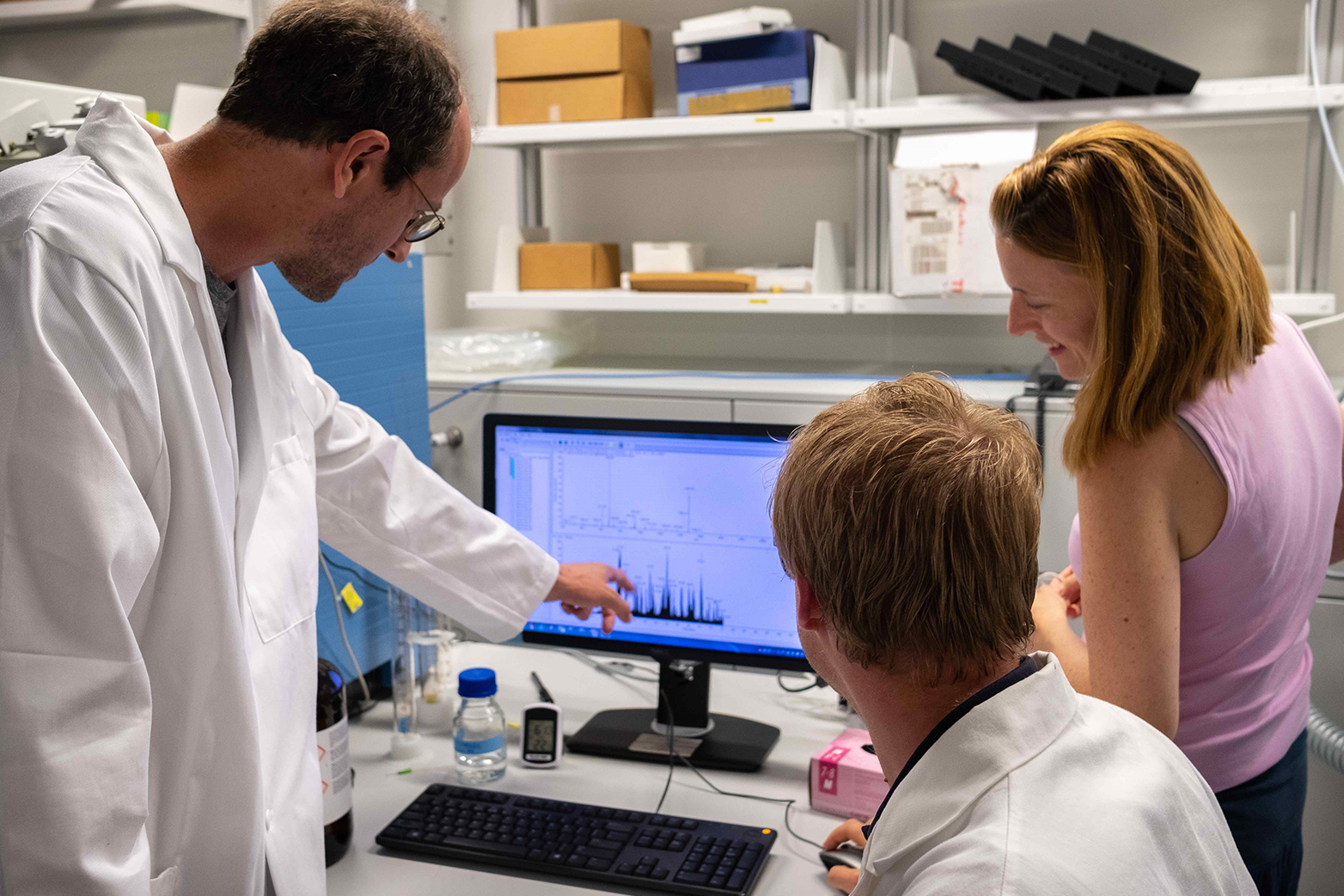
Which proteins are
essential for cell division? The biochemist Philipp Wild (left) and his
colleagues Ilaria Piazza and Christian Dörig examine the results from
the mass spectrometer. (Photograph: ETH Zurich / Adrian Henggeler)
Within our body, the process of cell division is constantly
creating new cells to replace old or damaged ones. The genetic
information is also duplicated and passed on to the new cells. Complex
interaction of many different proteins ensures a smooth process. This is
because these proteins immediately repair any errors that creep in
during DNA duplication. However, the same protein machinery also
performs another function: in germ cells that divide to from gametes –
egg cells and sperm – it is responsible for mixing the genetic
information of the original maternal and paternal side during cell
division. The same mechanism therefore has to resolve two conflicting
problems: in normal cell division, called mitosis, it ensures genetic
preservation, while in the cell division to produce gametes, or meiosis,
it ensures genetic diversity.
